 Chaingpt
 staking links longer locks to higher points multipliers
Chaingpt staking assigns membership points to locked CGPT using the selected pool's multiplier. Longer commitments typically earn more points per token, which can improve tier access and campaign benefits. The decision turns on whether those additional benefits justify losing access to the tokens during the lock. A points multiplier doesn't describe the pool's token yield.
Compare the intended benefit before choosing a duration. A higher tier can change participation rights or allocation weight, while campaign eligibility, registration, and timing still govern access. The lock continues under its pool terms even when a particular opportunity ends.
Funding and confirming a CGPT stake
Consider a wallet holding CGPT for an eligible staking pool, with the aim of reaching a usable membership tier. The missing prerequisite is enough BNB on BNB Chain to pay the staking transaction fees. Without that balance, the staking transaction can't complete, regardless of the CGPT available.
Resolve the fee balance before committing tokens. Compare the available pools on the same basis: points credited for the same CGPT amount, alongside the time each pool restricts withdrawal. Select the duration only after identifying which resulting tier supplies the intended benefit.
On ChainGPT Pad's staking page, connect the wallet on BNB Chain, select the pool, and enter the CGPT amount. Review the requested transactions before confirming them in the wallet. Then inspect the stake's transaction status and the account's points and tier. A successful staking transaction should correspond to the recorded stake, points, and tier. If the transaction remains pending or the balances disagree, stop before submitting another stake; first establish what the original transaction changed.
How does a longer lock change staking points?
A longer lock changes points through the multiplier assigned to its pool, rather than through a universal daily accumulation rule. Staking points equal the staked CGPT amount multiplied by the pool multiplier. The pool selection therefore affects how much membership weight the same token balance produces.
For comparison, let the intended tier require T points and the chosen pool have multiplier M. The corresponding token requirement is T divided by M. This relationship explains the attraction of a higher multiplier without assuming a particular token balance, duration, or live pool setting.
Holding the token amount constant makes the trade-off clearer. More points may cross a tier threshold, or they may leave the account within its existing tier. Those outcomes don't necessarily deliver the same additional access.
Pool options and multipliers can change. Use the terms attached to the available pool when evaluating a new commitment; a duration alone doesn't establish its points calculation.
Does a higher multiplier mean more token rewards?
A higher points multiplier doesn't necessarily mean more token rewards, because membership weight and staking yield describe different outputs. ChainGPT's August 2024 approved staking proposal included pools with no token yield and higher points multipliers. That structure makes access benefits central to the comparison.
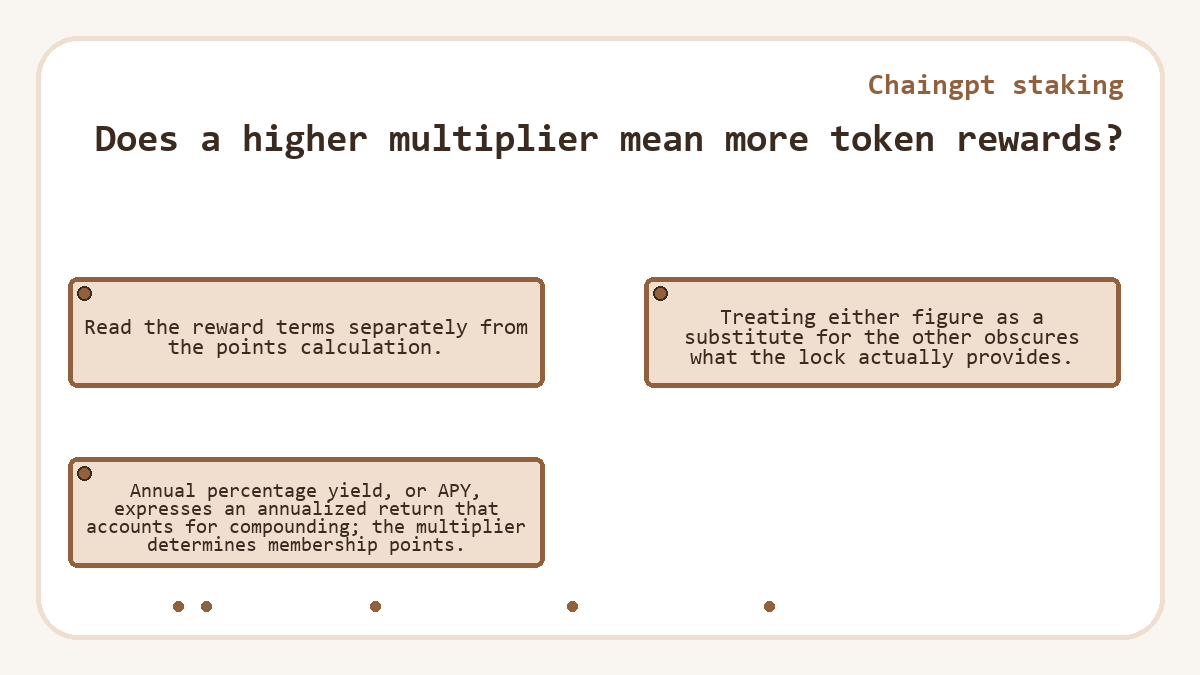
Read the reward terms separately from the points calculation. Annual percentage yield, or APY, expresses an annualized return that accounts for compounding; the multiplier determines membership points. Treating either figure as a substitute for the other obscures what the lock actually provides.
The tier benefit must match the intended campaign
Bronze, Silver, Gold, and Diamond identify membership levels, but the applicable campaign determines which benefits each level supplies. Standard tiered token offerings use membership for access, rounds, and allocation weight. Subscription public sales can instead use staking for allocation boosts or fee reductions.
This distinction changes the value of extending a lock. Access to an otherwise unavailable round differs from a discount on an event that already accepts eligible participants without staking. Compare the actual change in participation terms.
A higher allocation weight also differs from a fixed purchase entitlement. The campaign's allocation method and other participants affect the outcome. A membership upgrade alone doesn't establish the number of sale tokens an account will receive.
Identify the specific benefit before assigning value to extra points. If the relevant campaign charges no participation fee across tiers, a fee discount supplies no additional saving for that campaign. Other tier benefits may still matter.
Eligibility snapshots can precede the opportunity
A campaign can determine eligibility from an earlier snapshot, so a higher tier displayed today may not alter that campaign's allocation. Registration, identity checks where required, and the snapshot's timing remain separate conditions. A longer lock cannot retroactively create a qualifying balance at an earlier observation time. Compare the commitment date with the campaign's eligibility window before treating that event as a reason to extend the lock.
Can locked CGPT leave a pool early?
Early withdrawal is available only where the selected pool explicitly supports it; most pools restrict withdrawal until their staking period ends. Reaching a membership tier doesn't remove that restriction. Nor does the end of a sale automatically release the CGPT that qualified the account.
The unlock date governs when you can unstake through the staking page. In v2 pools, adding tokens extends the lock proportionally to the amount added, so the withdrawal date can change. Migration from v1 to v2 preserves the existing points and lock duration. Any vesting schedule for tokens obtained through a campaign governs a separate balance. Combining those dates would overstate how much cryptocurrency becomes available when either period ends.
During the lock, CGPT's market value can change while withdrawal remains unavailable. A stronger tier doesn't offset that exposure mechanically. The comparison therefore includes how long the tokens remain committed, alongside the benefits attached to the points.
Splitting commitments across eligible pools
CGPT stakes across multiple eligible pools can contribute to the same wallet's aggregated tier points. Each placement contributes according to its own amount and multiplier.
Splitting a balance can distribute its commitment across different lock periods, although each stake retains its own withdrawal conditions. Compare that arrangement with placing the entire balance into one pool using the same total CGPT amount. It may produce fewer points than committing everything to a higher multiplier, while leaving some tokens subject to a shorter lock.
The relevant question is whether the combined points support the intended benefit. Splitting adds no automatic tier advantage by itself.
Additional benefits have their own participation rules
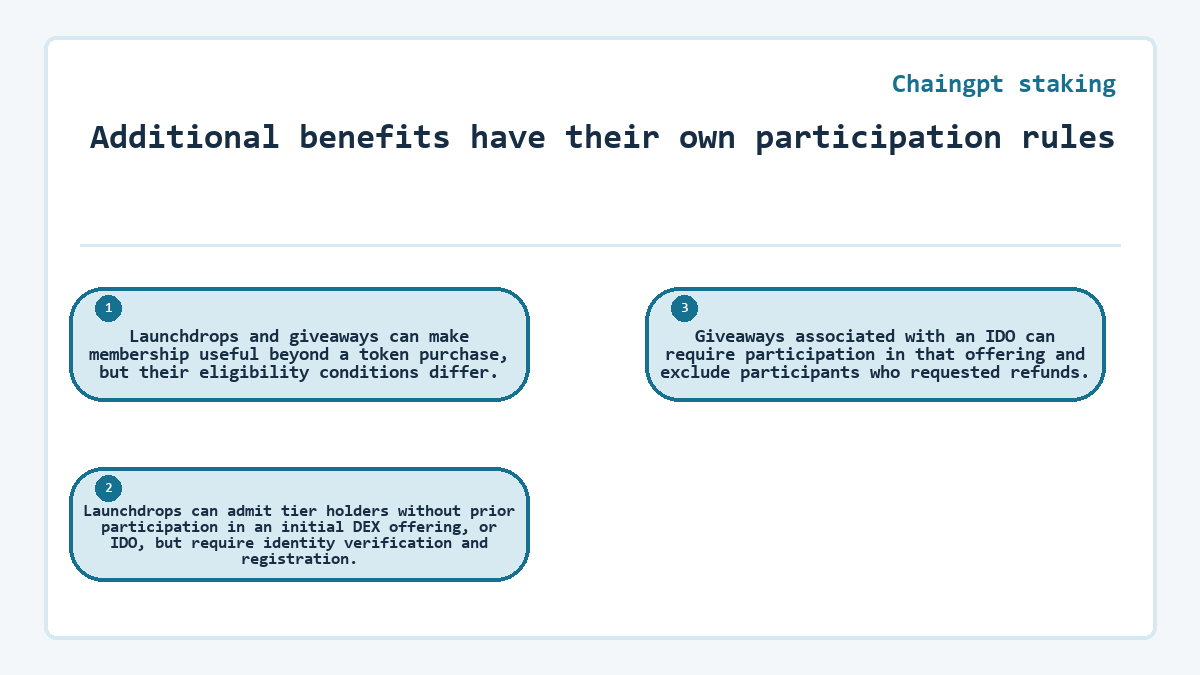
Launchdrops and giveaways can make membership useful beyond a token purchase, but their eligibility conditions differ. Launchdrops can admit tier holders without prior participation in an initial DEX offering, or IDO, but require identity verification and registration. Giveaways associated with an IDO can require participation in that offering and exclude participants who requested refunds.
Buzz campaigns introduce another distinction: staking can affect a campaign points boost and eligibility for a staker reward share. Those are separate mechanisms. Campaign settings determine the eligible activity, registration conditions, and reward treatment.
These benefits strengthen a lock's usefulness only when the account can participate. Staking also supports DAO voting when voting is enabled, with voting weight governed by DAO rules. Qualifying Diamond stakers can receive a monthly AI credit allowance through the Freemium plan; premium tools consume those credits, so the benefit doesn't mean unrestricted use of every AI tool.
Conditions that justify the extra commitment
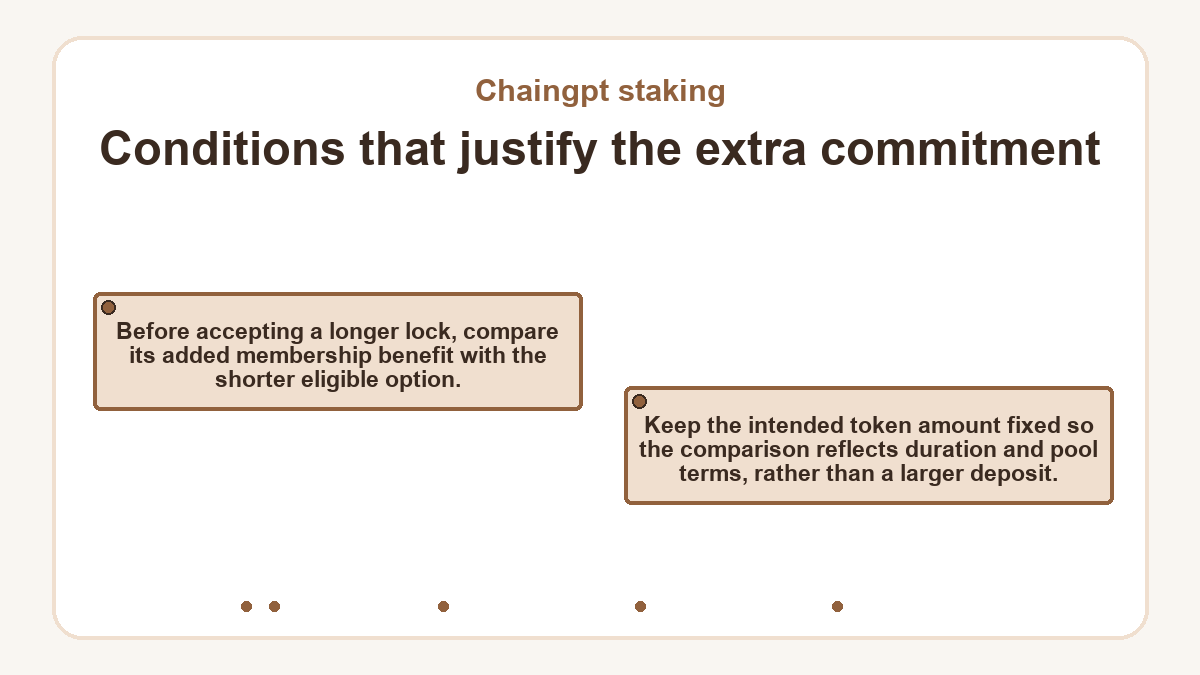
Before accepting a longer lock, compare its added membership benefit with the shorter eligible option. Keep the intended token amount fixed so the comparison reflects duration and pool terms, rather than a larger deposit.
- The longer pool's multiplier produces a meaningful points increase for the intended tier or campaign.
- The account meets any applicable registration, identity, regional eligibility, and timing requirements.
- The extra benefit applies to the chosen event, including any fee or allocation conditions.
- The pool's withdrawal date fits the period during which the tokens can remain committed.
- The reward terms distinguish token yield from membership points.
A shorter pool can supply the required tier with an earlier withdrawal opportunity. A longer pool can supply additional points with less CGPT committed, or greater membership weight for the same amount. Neither comparison works without naming the benefit that those additional points change.
What readers ask about Chaingpt staking
Does staking CGPT through an exchange count toward a membership tier?
Exchange staking campaigns don't automatically contribute points to ChainGPT's membership system. Tier points require participation through its qualifying staking mechanism. The same CGPT ticker can appear in different products with different accounting rules. An exchange reward balance therefore doesn't establish a corresponding launchpad tier.
Can delegated staking points support a tier in another wallet?
The staking delegation feature allows points to support another wallet's membership tier. It also allows the delegator to revoke previously assigned points. A receiving wallet should therefore distinguish its own stake from points that another account can withdraw from delegation. This feature concerns points assignment; it doesn't establish permission to withdraw the underlying locked CGPT.
Will a CGPT price increase raise my staking points?
A CGPT price increase doesn't directly raise points under the staking formula. The calculation uses the number of tokens staked and the pool multiplier, rather than their market value. With those inputs unchanged, a market price movement leaves the calculated points unchanged. The financial value of the locked balance can still move.
Are earlier Buzz points increased after a staking boost activates?
A staking boost applies to eligible Buzz points earned after activation, rather than increasing earlier points retroactively. The campaign also determines which activities the boost covers. Extending a lock to obtain a stronger boost therefore doesn't imply that previously completed activity will receive the higher multiplier.
Is identity verification required before staking CGPT?
Staking generally doesn't require identity verification, although later campaign participation or claims may require it. The relevant distinction is between entering the staking pool and using a benefit attached to the resulting tier. Completing the stake doesn't establish eligibility for a sale with separate identity requirements.