 Chaingpt
 contract testing against written requirements
Chaingpt generates Solidity contracts from natural language requirements, giving you code to compare against a written specification. Define the permitted action, required starting state, and expected result before testing. Then compare execution with those expectations, including a call that should fail. Successful compilation establishes that the compiler accepts the code; behavioral tests address whether it implements your requirements.
The generator also provides contract explanations and supports compilation. Keep the explanation beside the code during review, while using executable checks to resolve disagreements between them. A description of intended behavior doesn't establish what a function actually does.
Key takeaway: A generated contract meets a requirement only when its behavior matches the intended permission rules and state changes under the tested conditions.
An authorized change and a rejected call
Consider a hypothetical requirement: only an authorized account may change a stored setting. Before testing the generated contract, record the account that holds permission, the initial setting, and the intended replacement. Use an isolated test environment with a reproducible initial state. The normal test calls the function from the authorized account and checks that storage contains the replacement.
For the edge case, restore that initial state and repeat the call from an account without permission. Expect the permission check to reject the call and leave the setting unchanged. A failure caused by an unrelated setup error doesn't demonstrate that authorization works.
If the unauthorized account succeeds, preserve the failing test and identify the missing or incorrect restriction. Limit the repair to that defect where possible. Don't change the expected result simply to accommodate the output. Completion requires the authorized test and rejection test to pass against the same revised build.
- If the initial permission assignment is unclear, resolve it before interpreting either test.
- If the authorized call changes the wrong setting, inspect the function's storage writes.
- If the unauthorized call succeeds, hold deployment while repairing the permission check.
- If rejection comes from an unrelated error, correct the setup and repeat the permission test.
- If both tests pass, retain their results with the exact code revision that they exercised.
A reproducible starting state
A useful test record connects each requirement to the code revision, execution conditions, and expected state that give its result meaning.
Preserve the original prompt and generated files before editing. Write down constructor arguments, initial permissions, and any external contract dependencies that the implementation actually uses. These details explain the environment in which a function operates. A permission test against an incorrectly initialized contract can produce a misleading failure.
Record the compiler version, dependency versions, optimizer settings, and target execution environment. Solidity's build metadata includes compiler and compilation settings that help identify a build. Changing an imported library or compiler setting can change the artifact under review, even when the main source file looks unchanged.
Keep expected results separate from generated explanations. The requirement should determine the assertion. Otherwise, a test that merely repeats the implementation's assumptions can approve the same mistake that the code contains.
Does compilation prove that a generated contract meets the prompt?
Compilation doesn't prove that a generated contract meets the prompt; it checks the source against compiler rules and produces deployment artifacts when successful.
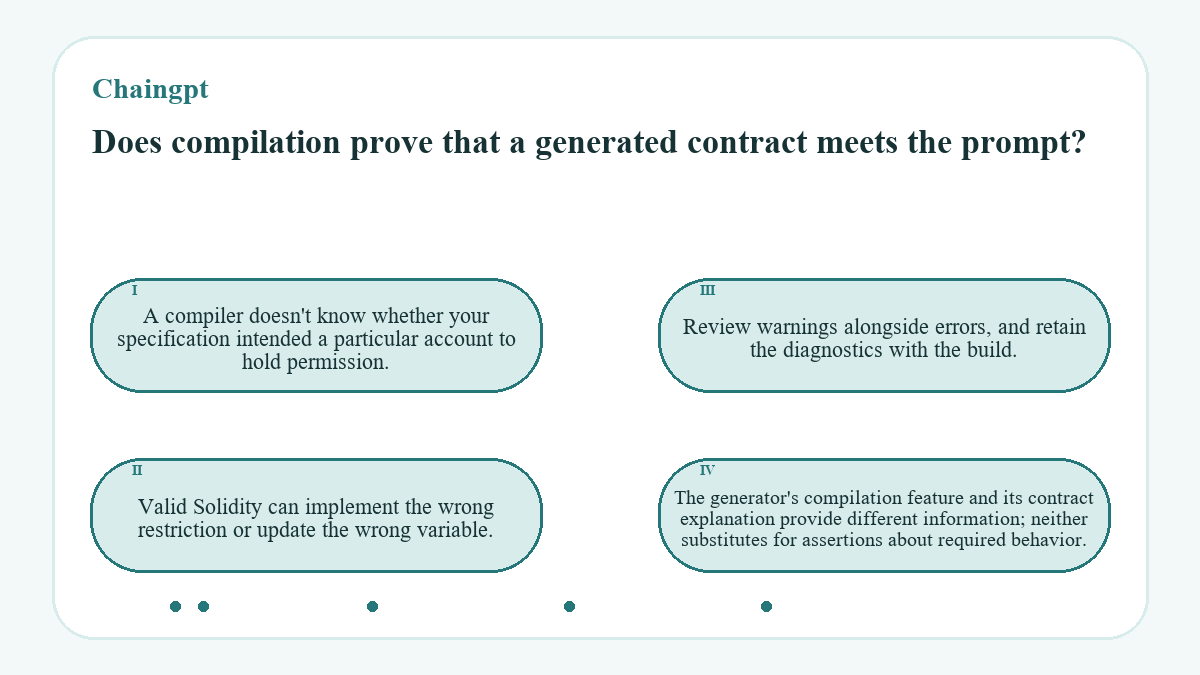
A compiler doesn't know whether your specification intended a particular account to hold permission. Valid Solidity can implement the wrong restriction or update the wrong variable. Review warnings alongside errors, and retain the diagnostics with the build. The generator's compilation feature and its contract explanation provide different information; neither substitutes for assertions about required behavior.
Permission checks and stored results
Permission requirements need separate assertions for allowed behavior and forbidden behavior, because either branch can fail while the other appears correct.
Caller permissions
Permitted calls
A permitted call needs the intended caller, valid arguments, and the required starting state. Its assertions should cover the resulting storage changes and any required return value. An interface notification alone doesn't establish that the contract performed the intended operation.
Restricted calls
A rejection test should establish that the authorization restriction caused the failure. An unrelated error can satisfy an overly broad expectation that a call must fail. Where the implementation exposes a specific permission error, checking that error makes the test more discriminating.
State after execution
A Solidity revert undoes state changes within the reverting call and its subcalls. An outer caller can sometimes catch a failed external call and continue, so the scope of the failure matters. Inspect the relevant contract state rather than assuming that every nested failure rejects the entire transaction.
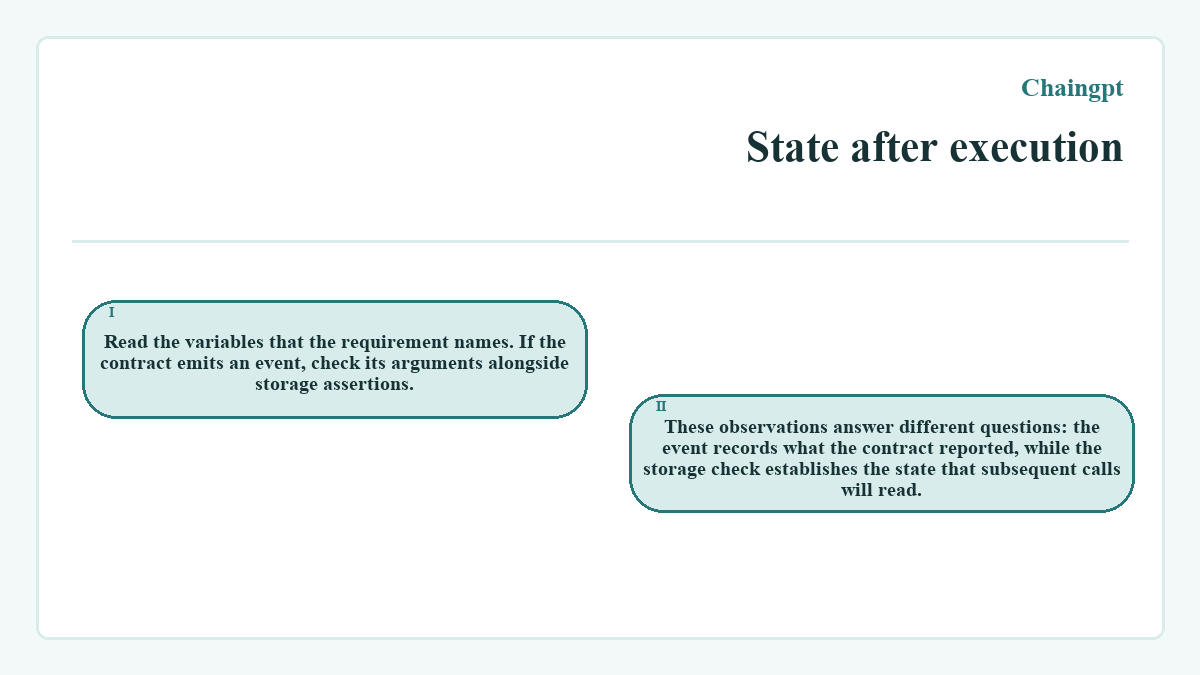
Read the variables that the requirement names. If the contract emits an event, check its arguments alongside storage assertions. These observations answer different questions: the event records what the contract reported, while the storage check establishes the state that subsequent calls will read.
Which tests expose gaps beyond the expected call?
Boundary tests, invariant checks, and integration tests examine conditions that a successful expected call leaves unexplored.
Boundary tests address the edges of an actual rule, such as an allowed range or a permission transition. An invariant expresses a property that must remain true across permitted operations. Integration tests examine interactions between contracts. Use the mechanisms present in the generated code to choose these checks, rather than adding unrelated cases. Testing individual functions and their interactions addresses different kinds of defects.
External calls deserve particular attention when the implementation contains them. Another contract can execute code during an interaction and potentially call back before the original operation finishes. Review the order of checks, storage updates, and external interactions against the properties that must remain true. This concern applies to the generated implementation's actual call paths.
Revisions that preserve the original requirements
A repair request should identify the failed requirement, relevant function, starting conditions, expected behavior, and actual result. Include the smallest code context that explains the defect, expanding it when dependencies matter. Asking only to make the contract safer gives the generator little information about the specific mismatch.
Compare the returned revision with the previous code before accepting it. Check for unrelated changes to permissions, initialization, interfaces, and storage. Preserve existing assertions unless the requirement itself changes. A passing replacement test isn't evidence of a repair when it silently weakens the original expectation.
Repeat the failing test and the relevant regression tests after the change. Broaden testing when the revision affects shared logic or interacting contracts. Keep unresolved failures visible, and separate them from failures caused by an incomplete test environment.
A handoff tied to the tested build
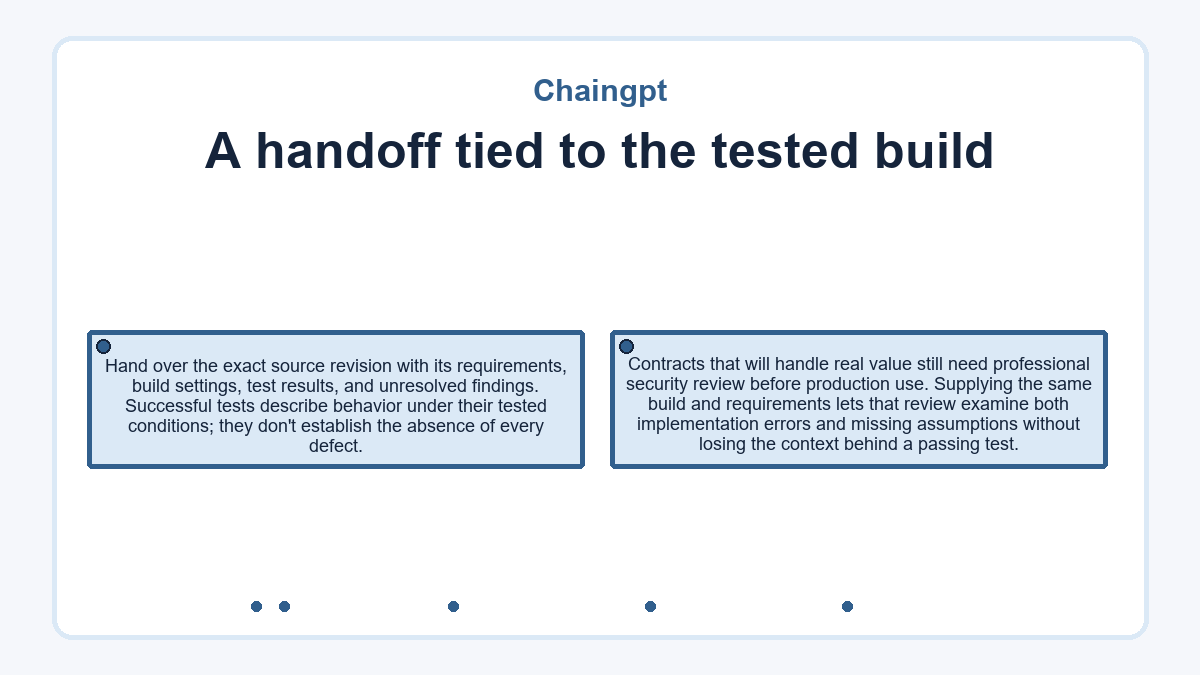
Hand over the exact source revision with its requirements, build settings, test results, and unresolved findings. Successful tests describe behavior under their tested conditions; they don't establish the absence of every defect. Contracts that will handle real value still need professional security review before production use. Supplying the same build and requirements lets that review examine both implementation errors and missing assumptions without losing the context behind a passing test.
What to know about Chaingpt
Can generated tests share the same mistake as a generated contract?
Generated tests can repeat the assumptions that produced an incorrect contract. Write expected outcomes from the requirements before comparing them with the implementation. Review assertions for missing restrictions or unintended permissions, especially when the same prompt produced both files. Agreement between generated code and generated tests doesn't independently establish that either matches the intended behavior.
Why does the same contract pass alone and fail in a test suite?
Tests can interfere with one another when they share state or depend on execution order. Earlier calls may change permissions, stored values, or initialization conditions. Compare the failing test's starting state with its isolated run. Restore the intended setup between independent tests, and make any deliberate sequence of dependent operations explicit.
Is complete code coverage enough to accept generated Solidity?
Complete code coverage doesn't establish that the assertions capture every requirement. Coverage measures which code the tests execute under the chosen metric. A test can execute a branch without checking its important consequences. Use coverage to identify unexamined paths, then assess whether the assertions detect incorrect permissions, unexpected state changes, and other relevant failures.
Does marking a contract variable private protect confidential information?
A private Solidity variable doesn't make its contents confidential on a public blockchain. The visibility restriction controls access through Solidity code, rather than concealing blockchain data. Keep secrets out of generated contracts and deployment arguments. If confidentiality forms part of the requirements, ordinary private storage doesn't satisfy that requirement.
How should a reviewer handle conflicting requirements in the prompt?
Resolve conflicting requirements before treating either interpretation as the expected test result. Identify the operations and conditions that overlap, then state which rule takes precedence. Preserve that clarification with the prompt and tests. Otherwise, a generated contract can satisfy one sentence while violating another, leaving a passing test dependent on an undocumented interpretation.