 Chaingpt
 chatbot troubleshooting for unclear crypto answers
Chaingpt chatbot troubleshooting starts with comparing the reply against the exact question and its stated conditions. Preserve the original exchange before changing the prompt, then identify whether the answer misunderstood the task, missed earlier context, or stopped before completion. A useful correction addresses that specific mismatch. For a crypto question, the missing detail might concern the network, the meaning of a balance, or the time period behind a claim. Add only information relevant to the question. If the reply requires a fact that you don't have, leave that point unresolved rather than accepting a confident guess. Repeating the request without isolating the problem gives you little evidence about its cause.
A complete reply that answers the wrong question
When the response looks finished but discusses a different crypto operation, compare its first substantive claim with your original request. Save the prompt and the relevant answer excerpt before editing either. Identify the specific substitution: an explanation of availability in place of eligibility, for instance. Begin with a wording correction that doesn't change account settings. If the same mismatch persists, preserve the exchange for further diagnosis rather than repeatedly broadening the question.
What makes a corrected crypto answer usable?
A corrected answer is usable when it addresses the requested operation, preserves its conditions, and clearly identifies any remaining unknown. Readability alone doesn't establish factual accuracy. An explanation of staking eligibility, for example, must distinguish the eligibility requirement from a description of staking rewards. A reply that substitutes one for the other hasn't answered the question. If acting on the answer requires an unresolved balance, permission, or account condition, that missing input still blocks the decision.
Missing details in the prompt
Replace ambiguous references with the information that distinguishes the intended question from nearby questions. More context helps only when it resolves a specific ambiguity; unrelated background makes the correction harder to assess.
The operation and its observed state
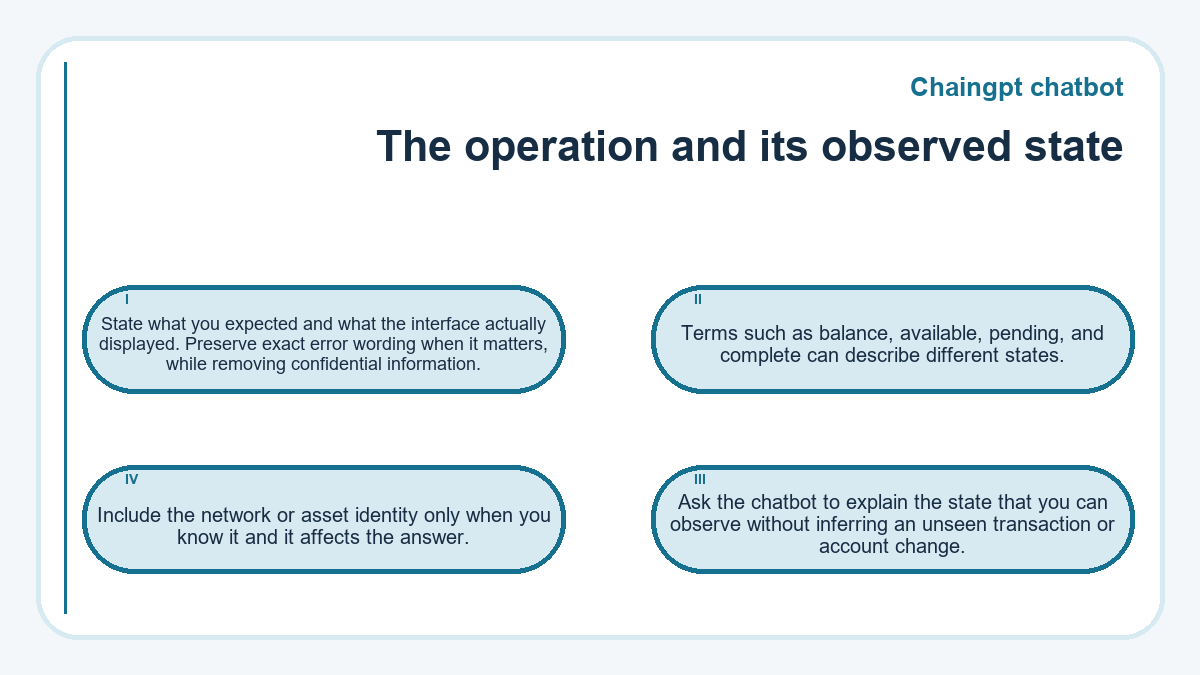
State what you expected and what the interface actually displayed. Preserve exact error wording when it matters, while removing confidential information. Terms such as balance, available, pending, and complete can describe different states. Ask the chatbot to explain the state that you can observe without inferring an unseen transaction or account change. Include the network or asset identity only when you know it and it affects the answer.
Time scope and terminology
A question about a changing requirement needs a time scope. Separate a request for the underlying mechanism from a request for a present value. Asking for plainer language can resolve unfamiliar terminology, but it can't establish a missing fact. Preserve technical names and qualifiers when requesting a simpler explanation, especially conditions that restrict who can perform an action.
Why does the chatbot forget earlier details?
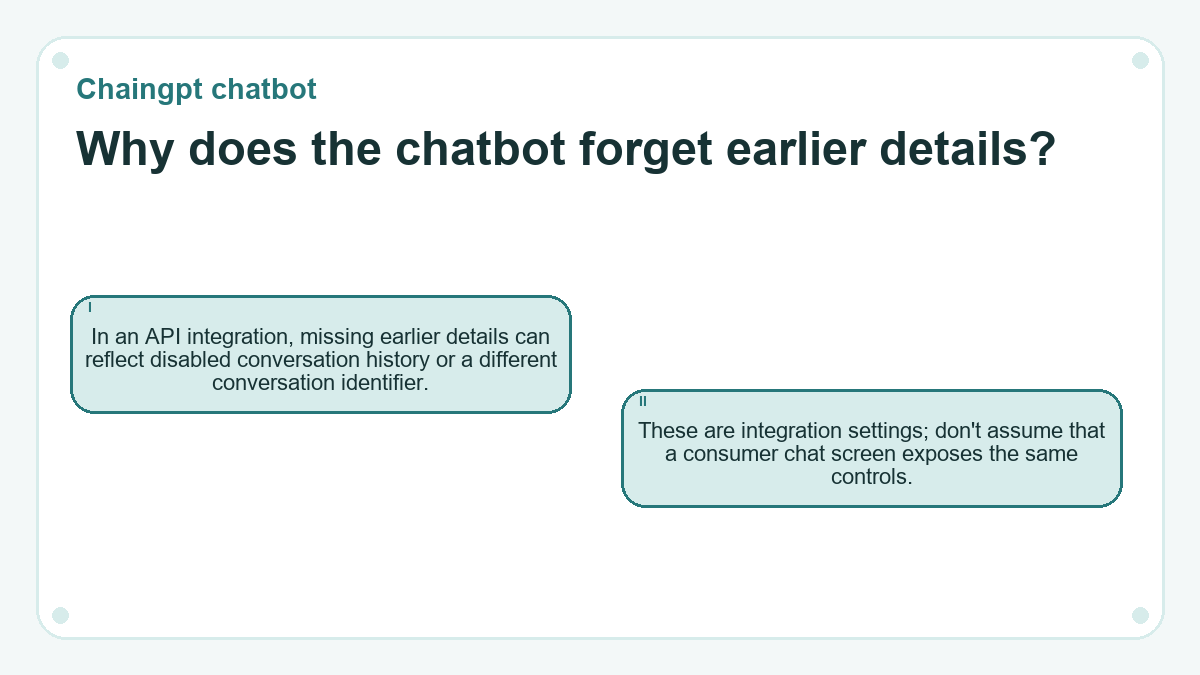
In an API integration, missing earlier details can reflect disabled conversation history or a different conversation identifier. These are integration settings; don't assume that a consumer chat screen exposes the same controls.
History settings and conversation identifiers
The chatbot API treats requests independently when
chatHistory
is
"off".
History-enabled requests use
sdkUniqueId
to group a conversation. An integration that changes that identifier between related requests may lose the intended continuity. Omitting it groups history-enabled requests under the same API key, which can mix otherwise separate discussions. These documented relationships help distinguish a context problem from an unclear prompt.
Visible messages and transmitted context
A transcript on the screen doesn't establish which information an application included in its request. Someone maintaining the integration can compare the submitted question and context settings with the visible conversation. Someone using the chat can include the necessary background directly in a self-contained question. Neither action proves that the resulting explanation is correct; it removes uncertainty about whether the question contained the required detail.
Custom context behind off-topic replies
A chatbot embedded in another application may receive project information or response instructions beyond the text that you type. The integration's custom context can therefore explain a repeated emphasis that your question never requested. Consider this possibility when the reply consistently discusses an unrelated project detail or adopts an unhelpful tone.
The chatbot supports request-specific custom context through
contextInjection
when
useCustomContext
is enabled.
Ask the integration maintainer to inspect the relevant settings before changing a shared configuration. Tone changes concern presentation; they don't establish whether a crypto claim is correct. Treat custom context as a possible cause to investigate, not a diagnosis that the wording alone proves.
Incomplete replies and access errors
An answer that ends halfway through a sentence needs a delivery check before a prompt rewrite. Distinguish an unfinished response from a complete answer that lacks detail.
The SDK supports streamed answers and complete responses. Streaming delivers text in chunks, so an application must collect those chunks and handle completion. A display that contains only part of the delivered text can resemble a reasoning failure.
For an integration, compare the received response with the text that the interface displays. Keep response completion and answer quality as separate checks.
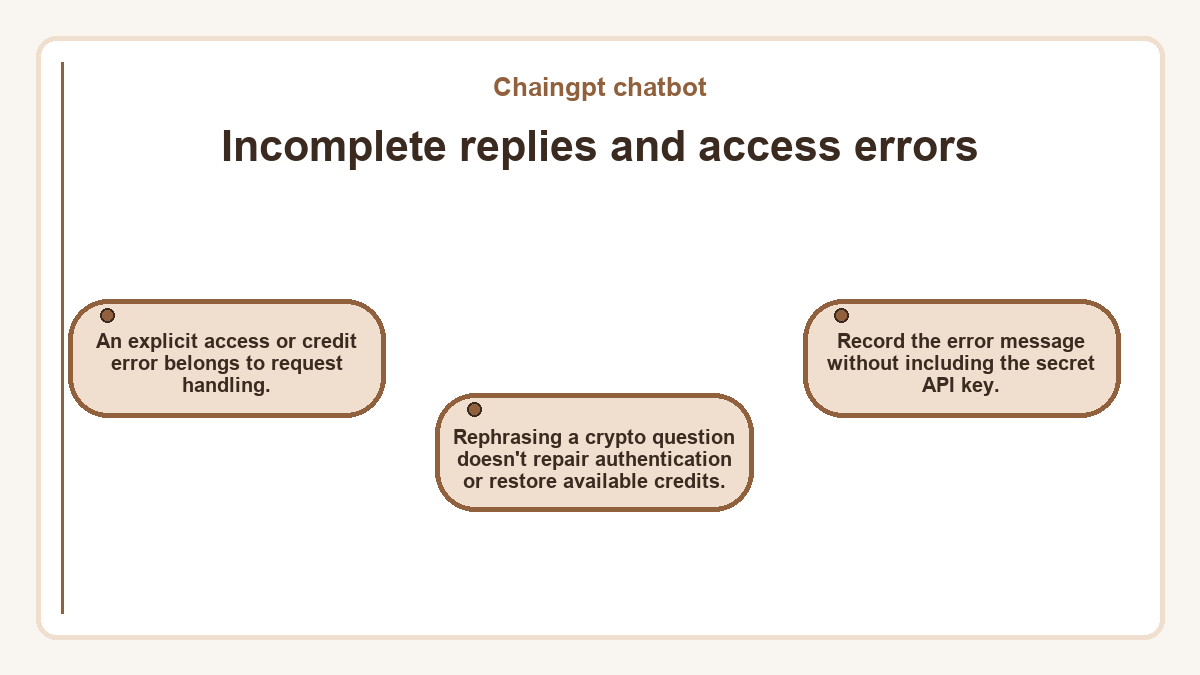
An explicit access or credit error belongs to request handling. Rephrasing a crypto question doesn't repair authentication or restore available credits. Record the error message without including the secret API key.
A retry is appropriate after identifying an interruption or correcting the relevant request condition. Don't choose an arbitrary waiting period for every failure. If the same interruption recurs, retain its timing and error details for the application maintainer.
A controlled retry and verification checklist
Suppose a reply ignores a condition that you supplied earlier, while you expected that condition to govern the explanation. Compare a follow-up in the existing conversation with a self-contained question using the same requirement. The comparison concerns whether each answer applies that requirement, not which answer sounds more polished.
- If the original exchange contains the condition, preserve the relevant prompt and answer excerpt before retrying.
- If the follow-up relies on earlier messages, make the replacement question self-contained while keeping its substantive requirement unchanged.
- If the revised reply addresses the condition, check that it also preserves the requested operation and identifies missing information.
- If the revised reply still ignores the condition, stop rewording and report the mismatch with a sanitized exchange and any visible error.
- If the answer now matches the request, accept that the omission has cleared while keeping any unresolved factual claim separate.
A self-contained question reduces reliance on conversation continuity, although it requires repeating relevant context. If it succeeds where the follow-up failed, that difference supports investigating context handling; it doesn't prove a particular setting caused the failure. The next decision is whether the corrected explanation resolves your question or whether an unresolved account condition needs support.
Chaingpt chatbot: questions and answers
Can I use a screenshot to report an unclear chatbot answer?
A screenshot can document the visible mismatch, although searchable text makes exact wording easier to compare. Include the relevant question and reply, and redact account details or unrelated conversations. Don't assume that the chat interface accepts image input; a screenshot can accompany a support report through a channel that supports attachments.
Does asking the chatbot for a confidence score help resolve conflicting answers?
A requested confidence score doesn't establish which conflicting answer is correct. Ask it to identify the assumption that differs between the answers and the condition that would resolve the disagreement. An explanation that leaves that condition unknown should retain the uncertainty, regardless of how confident its wording sounds.
Should I include my recovery phrase when asking about a confusing wallet explanation?
Never include a recovery phrase or private key in a chatbot prompt. Those secrets aren't necessary to explain a visible message or clarify terminology. Describe the operation and relevant state instead. Review pasted logs and screenshots for secrets before sharing them, including material intended for a support report.
How can I request simpler wording without losing technical conditions?
Ask for a plain-language explanation that preserves the original conditions and defines unfamiliar terms. Keep identifiers and technical names unchanged. Avoid requesting only a shorter answer when the missing detail concerns an exception: shortening may remove the very condition that you need to understand.
Is a different answer to the same prompt proof of a service fault?
Different wording alone doesn't prove a service fault. Compare the substantive claims and their conditions before treating the replies as contradictory. If they make incompatible claims about the same question, preserve both answers and identify the exact disagreement instead of choosing whichever explanation sounds more convincing.
What details help support investigate a recurring chatbot mismatch?
A useful report includes the exact question, the relevant answer excerpt, the expected interpretation, and when the mismatch occurred. Name the interface that you used and include any visible error. Integration maintainers can also provide sanitized request settings and the SDK version, without exposing credentials or unrelated conversation history.